Reading crypto charts comes down to three things: price (what it’s doing), trend (where it’s likely headed), and confirmation (whether the move is real or just noise). You do not need advanced math or expensive software to get started, but you do need a consistent framework.
This guide covers the chart types you’ll see most often, how candlesticks work, and the beginner-friendly indicators that matter most. If you’re looking for a place to apply these skills, start with the best crypto trading platforms.
Key Takeaways
- Candlesticks first: Learn open, high, low, close (OHLC) and you can read most crypto charts confidently.
- Levels matter: Support and resistance help you plan entries/exits and manage risk more than “predictions” do.
- Trend filters help: Moving averages can reduce noise and keep you aligned with the bigger move.
- RSI and volume confirm: RSI can flag overbought/oversold conditions, while volume helps validate breakouts and reversals.
- Timeframe drives decisions: A setup that looks “bullish” on a 5-minute chart can look shaky on a daily chart.
What are crypto charts and why do they matter?
A crypto chart is a visual record of a coin or token’s price over time. Most charts also include volume (how much traded) and let you overlay indicators that help interpret trend and momentum using some of the best charting tools for traders.
Charts matter because crypto markets can move quickly, and emotions are expensive. Bitcoin, for example, has seen historic highs and notable pullbacks in recent cycles, reflecting crypto’s tendency toward sharp trend moves and volatility, as noted in market commentary from Amberdata’s Bitcoin Q1 2025 review.
Using charts does not guarantee profit, but it can help you avoid “buying because it’s going up” or “selling because it’s going down.”

A helpful mindset is that charts are less about certainty and more about stacking evidence so your decisions are repeatable.
How do line charts, bar charts, and candlestick charts differ?
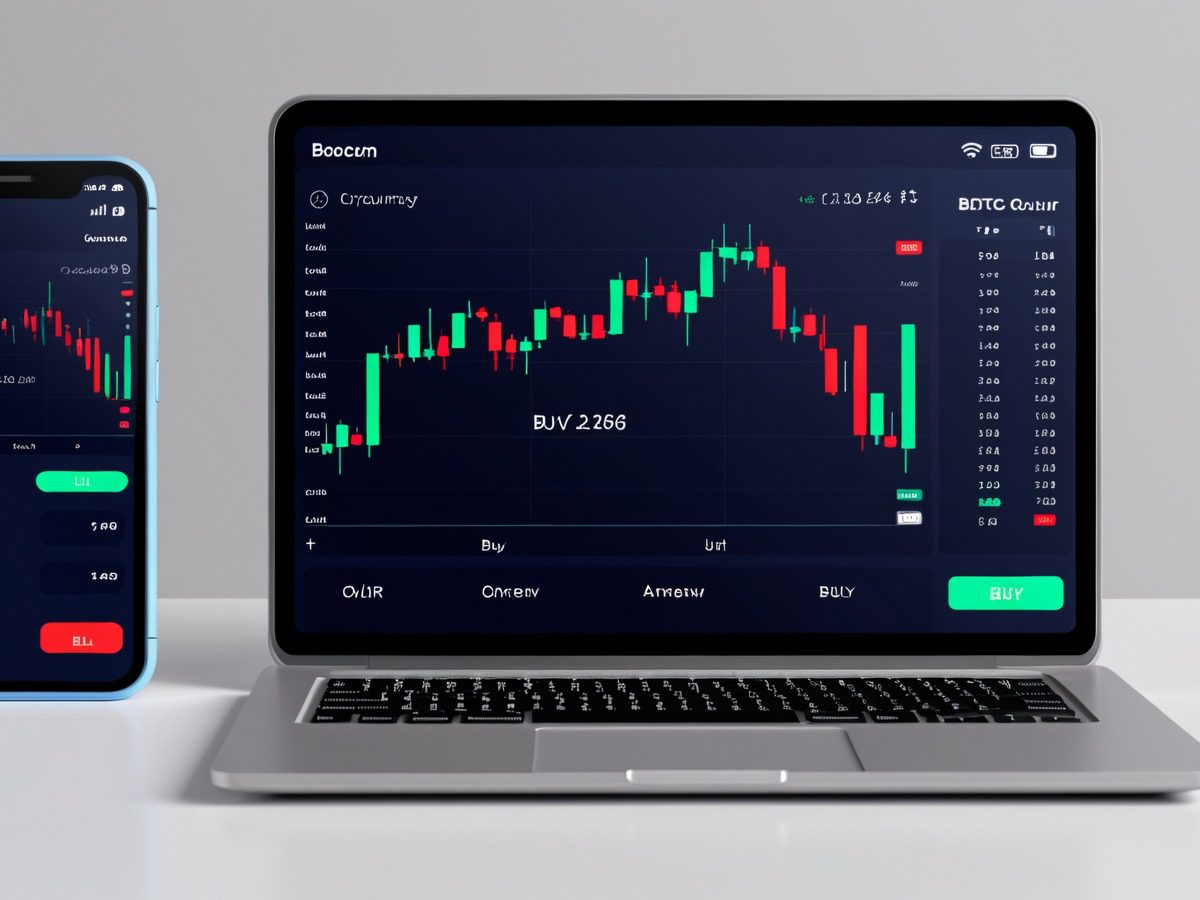
Candlestick charts are usually the best starting point because they show trend and momentum clearly without hiding the “messy” moves inside the day.
Most platforms offer three common views: line charts, bar charts, and candlestick charts. Line charts use a single line for a quick glance at trend, while bar charts show OHLC data in a format some beginners find harder to read at speed.
Candlestick charts also show OHLC, but the candle body makes direction and strength easier to see. Exchanges and charting platforms emphasize these formats because they show more information without becoming cluttered.
In practice, it also helps to start with clean data, so choose a solid venue for accurate price feeds. Binance’s overview of line, bar, and candlestick charts is a good reference for a quick visual comparison.
How do you read a single candlestick (open, high, low, close)?
A candlestick shows you the open, high, low, and close for a specific timeframe. That one snapshot tells you who was in control during that period.
Each candlestick summarizes price action for a chosen timeframe, such as 1 hour, 4 hours, or 1 day. The body represents the range between open and close, while wicks (shadows) show the highest and lowest prices reached.
Common interpretations include big bodies with small wicks, which indicate a strong directional move. Small bodies with long wicks suggest rejection and indecision where price tried to move but got pushed back.
If a candle closes near the high in an up candle, it means buyers maintained control into the period’s end. Once you can read one candle, you can read sequences of candles, which is where patterns come from.
Which candlestick patterns should beginners watch?
A few patterns are worth knowing because they show up often, but patterns are easy to overrate if you ignore context. Start with concepts like the Doji, which shows open and close prices are very close, hinting a move is tiring.
Engulfing candles occur when a candle body fully covers the prior candle’s body, signaling a shift in control. Hammer and shooting star shapes indicate rejection of lower or higher prices respectively.
The key is context: patterns near an important level matter more than patterns in the middle of nowhere. Patterns confirmed by volume also matter more than patterns on low activity.
For a beginner-friendly walkthrough, Crypto.com’s guide on how to read crypto charts is a solid supplemental reference.
How do you find support and resistance levels for better entries and exits?
Support and resistance are the most useful “indicators” you can learn because they help you plan entries, exits, and risk without guessing. Support is a price area where buying has historically been strong enough to stop declines.
Resistance is where selling has historically been strong enough to cap rallies. Savvy investors can monitor these more closely by researching what the best crypto screener is for their specific goals.
To draw them, zoom out to a higher timeframe like the daily chart and mark repeat reactions. Highlight areas where price reversed multiple times and treat levels as zones rather than exact pennies.
Use these levels for planning entries near support and managing risk by setting logical invalidation points. This approach also helps you avoid FOMO if price is running into a known resistance zone.
How do moving averages help you identify the trend?
Moving averages help you stay on the right side of the bigger move by smoothing out noise. This makes the underlying trend easier to see.
A moving average (MA) smooths price data to help you see trend direction. Simple moving averages (SMA) provide an average over a set period, while exponential moving averages (EMA) react faster to recent price changes.
Beginners can use them as a trend filter: if price is above a rising MA, the trend is generally up. In strong trends, price often pulls back toward a moving average and then continues, acting as dynamic support.
While crossover signals can suggest trend changes, they can lag in choppy markets. What actually matters here is using them as a filter so you stop fighting the dominant trend.
What does RSI tell you about overbought or oversold conditions?
RSI helps you spot when momentum looks stretched, which is useful for timing and risk. However, it is not a standalone buy or sell button.
The Relative Strength Index (RSI) is a momentum indicator scaled from 0 to 100. Typical thresholds include 70 for overbought conditions and 30 for oversold conditions.
Beginners can use RSI to watch for potential reversals when price hits support or resistance. Divergence, where price makes a new high but RSI makes a lower high, can also suggest momentum is weakening.
In strong trends, RSI can stay “overbought” or “oversold” longer than you expect. Use RSI with price levels and volume instead of treating it like an automatic signal.
How should volume influence what you believe about a price move?
Volume is the “receipt” because it shows participation. Moves with real participation are usually more reliable than moves on thin trading.
A breakout with rising volume is more credible because more traders are agreeing with the move. Conversely, a breakout on weak volume is more likely to fail or reverse.
Climactic volume after a long run sometimes signals exhaustion, especially if followed by rejection candles. Volume also matters because crypto participation keeps evolving through different assets.
Stablecoins like USDT and other stablecoins facilitate massive transaction volumes. Understanding this context helps you realize that liquidity and participation can shift quickly across venues.
Which timeframe should you use, and what mistakes trip up new traders?
You should use the timeframe that matches your strategy. The same chart can look bullish on a 5-minute view and fragile on a daily view.
Day traders use lower timeframes from 1-minute to 15-minute charts where noise is high. Swing traders often use 4-hour and daily charts for fewer decisions and clearer levels.
Common beginner mistakes include indicator overload and ignoring higher timeframes. Chasing green candles without identifying nearby resistance is another frequent error.
Entering trades without knowing where you are wrong is a major risk. Chart reading is only useful if it connects to a defined plan for risk management.
What are the best free tools to analyze real-time crypto charts?
TradingView and your exchange’s built-in charts are enough for strong beginner chart work. You only need to draw levels, view volume, and add one or two indicators.
TradingView offers a free tier with widely used charting, indicators, and alerts. Exchange charts from platforms like Coinbase, Kraken, and Binance.US are convenient for quick checks.
| Exchange | Spot Trading Fees | Supported Coins | Learn More |
|---|---|---|---|
| Coinbase | $0.99 - 2.00% (Standard), 0.05% - 0.60% (Advanced Trade)
For transactions above $200 (standard account): 1.49% fee for using a bank account or USD wallet, 3.99% fee for using a debit or credit card. For Coinbase Advanced Trade: 0.60% for taker trades and 0.40% for maker trades. The more you trade, the lower the fees - can decrease to as low as 0% - 0.05%. |
+250 | Read Review |
| Kraken | 0.40% - 0.25%
0.40% for taker trades and 0.25% for maker trades. The more you trade, the lower the fees - can decrease to as low as 0% - 0.10%. Using GT tokens to pay trading fees offers a 10% discount |
+300 | Read Review |
| Binance.US | 0.10%
For both maker and taker orders. The more you trade, the lower the fees - can decrease to as low as 0.04%. Users who pay fees using Binance Coin (BNB) receive a 25% discount |
+120 | Read Review |
When choosing tools, prioritize reliability and clear volume data. Educational guides from Crypto.com on reading token charts are also helpful refreshers.
To read crypto charts, focus on candlesticks, support and resistance, and trend via moving averages. Pick a timeframe that matches your strategy and practice marking levels regularly.
The most useful chart skill isn’t prediction; it’s building a repeatable process for making and managing decisions. Start with simple indicators and build your confidence over time.
